Our Approach to Karate
Karate means different things to different people. Some seek fitness and wellbeing, others confidence, personal development, self-protection, competition, or simply the enjoyment of learning and belonging.
At Brothock Shotokan Karate Club, our training is built upon three fundamental elements:
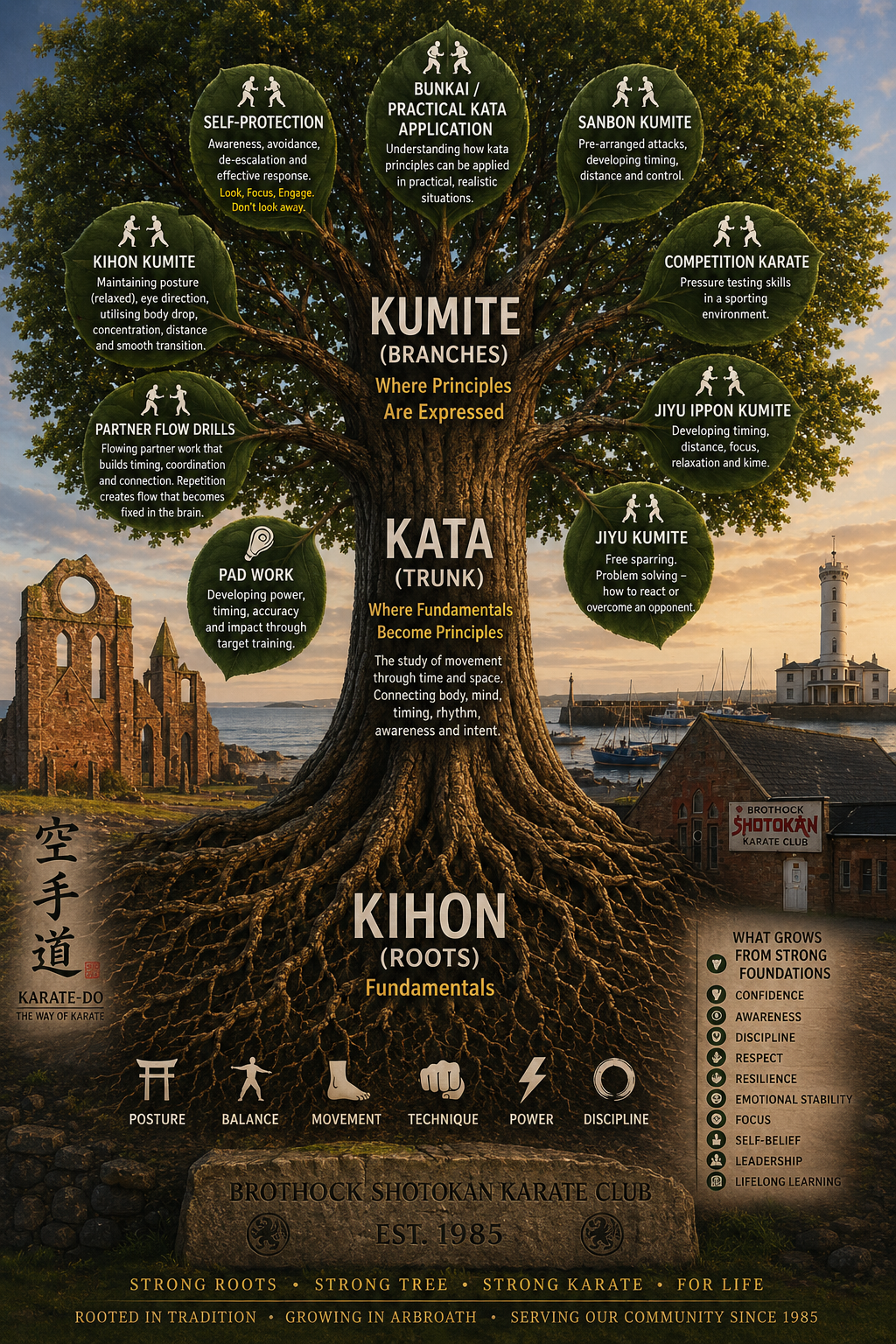
Kihon – Fundamentals
The roots of karate. Through kihon we develop posture, balance, movement, coordination, technique, power and discipline. Strong fundamentals provide the foundation upon which everything else is built.
Kata – Principles
The trunk of the tree. Through kata, fundamentals become principles. Students explore timing, rhythm, distance, body mechanics, awareness and intent, learning not just how movement works, but why.
Kumite – Expression
The branches of the tree. Kumite allows karate principles to be expressed through a variety of training methods, including partner work, bunkai / practical kata application, flow drills, breakaway techniques, and the application of body dynamics developed in kihon.
Together, Kihon, Kata and Kumite form the foundational trilogy of karate developing mind, body and spirit. Training improves fitness, flexibility, confidence, awareness, discipline, resilience and emotional control while providing a framework for lifelong learning and personal growth.
From these foundations, students may choose to explore many different branches of karate according to their own interests, goals and abilities.
Your karate journey is your own. Our role is to provide the strong foundations from which you can grow.
Self-Protection
Self-protection is a holistic concept and should not be confused with fighting.
In real life, the vast majority of staying safe lies in prevention rather than physical action. Awareness, confidence, posture, decision-making, avoidance and de-escalation play a far greater role than physical techniques alone.
Self-Protection
The overarching approach to staying safe, encompassing mindset, awareness, judgement, boundary-setting, avoidance, de-escalation and — only where unavoidable — physical response.
Personal Safety
The preventative behaviours that reduce risk before situations escalate, including awareness, posture, body language, confidence and the ability to recognise and avoid danger early.
Self-Defence
Proportionate physical action used as a last resort when personal safety has already been compromised and disengagement is required.
Where physical skills are explored, they are grounded in sound karate principles and realistic training. The objective is never to win a fight, but to create the opportunity to disengage and go home safely.
Competition Karate
Competition provides a consensual, rule-based environment for pressure testing skills. It can develop focus, emotional control, timing, distance and the ability to perform under stress.
Competition is not a requirement and is rule based and should never be confused with personal safety or self-protection. It is simply one branch of the karate tree — valuable for some, optional for all.
At Brothock Shotokan Karate Club, competition is viewed as a learning opportunity and one of many ways in which karate principles can be explored and expressed.